**Ruby in Fuchsite Sphere — Fluoresces Bright Red Under 365nm UV!**
**$30 each**
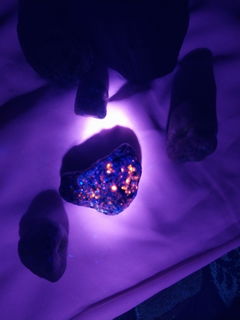
Two minerals, one sphere — and one element paints the whole thing. Chromium gives the ruby crystals their red color, gives the fuchsite matrix its green color, AND makes the rubies glow. Hit one of these spheres with a 365nm UV light and every ruby in it blazes bright red against the dark green stone, just like the photos — and these spheres carry big, bold ruby crystals you can spot clear across the room. In regular light it's a polished green sphere sprinkled with pink-to-magenta ruby crystals, and the fuchsite has a subtle sparkle from its mica flakes.
**What it is:** Ruby is the red variety of corundum — the same mineral family as sapphire, and at Mohs 9 it's second only to diamond in hardness. Fuchsite (named for German mineralogist Johann von Fuchs) is a chromium-rich green variety of muscovite mica. Ruby in fuchsite is a metamorphic rock that formed deep in the Earth's crust, where aluminum-rich rock was cooked under enormous heat and pressure until ruby crystals grew scattered through the green fuchsite. Some spheres even show thin blue-green kyanite rims around the rubies — look for them in the photos.
**Where it's mined:** Most ruby in fuchsite on the market, including these spheres, comes from southern India — mainly the metamorphic belts of Karnataka (the Kodagu/Madikeri district is the classic source), with material also from Tamil Nadu. India is one of the oldest ruby sources on Earth: rubies have been dug from Indian soil and traded there for over 2,000 years. The ruby-bearing rock is dug from small pits and shallow workings in deeply weathered ground, then the rough is cut and polished into spheres by Indian lapidaries.
**A little ruby history:** Ruby has been prized for thousands of years, and India is where much of that story starts. In ancient Sanskrit it was called *ratnaraj* — "king of precious stones" — and ancient Indian lapidary texts like the *Ratna Pariksha* were grading rubies by color and quality over a thousand years ago. Indian maharajas filled their treasuries with rubies, and India was famous for the stone centuries before the Burmese Mogok "Valley of Rubies" became known for its "pigeon's blood" red. Ruby is still July's birthstone and one of the four classic precious gems, alongside diamond, emerald, and sapphire. The chromium glow in these spheres isn't just pretty — in 1960 physicist Theodore Maiman used a ruby crystal's red fluorescence to build the world's first working laser. And fun fact: the famous "Black Prince's Ruby" in the British Crown Jewels turned out to be a red spinel — real rubies were so desirable that even kings got fooled.
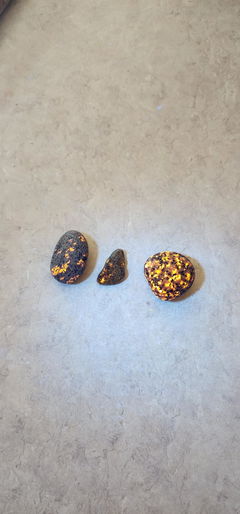
**Please note:** This is NOT a Yooperlite — Yooperlites are fluorescent sodalite from Lake Superior and glow orange. This is a different fluorescent mineral from India, and it glows RED. It makes a great companion piece for any fluorescent collection, and a great way to show off what your 365nm light can do.
**Details:**
- Natural ruby in fuchsite, polished sphere, from India
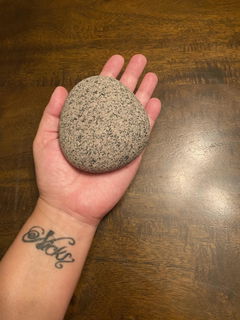
- Approximately 2 to 2.5 inches in diameter and about 9 ounces each
- **Stand NOT included** — the stand in the photos is for display only
- Every sphere is one of a kind — ruby coverage ranges from speckled to big bold crystals, exactly like the range shown in the photos. You'll receive one sphere from this batch.
- Photos show the actual batch, in white light and under 365nm UV
**Care:** Handle with a little respect — the rubies are Mohs 9, but the fuchsite matrix is a soft mica (about 2.5–3), so don't drop it on concrete or toss it loose in a rock bucket. Wipe clean with a damp cloth.