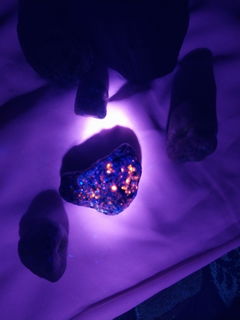
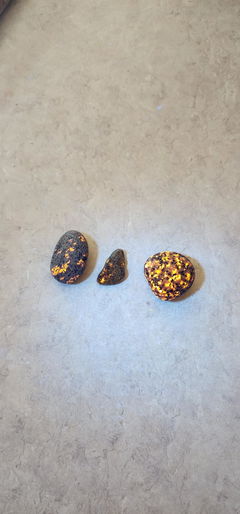
**Dyed Agate Pendant — Glows Orange Under 365nm UV!**
**$7 each — listing is for ONE random pendant**
A pendant with a secret. In regular light these are bright, banded agate pendants in sunset colors — orange, pink, red, yellow, and green, many of them with a crackled "dragon vein" pattern running through the stone. Hit one with a 365nm longwave UV light and the whole pendant lights up orange, with the bands and crackle lines glowing brightest — just like the photos. Each pendant comes fitted with a metal bail, ready to hang on your own chain or cord. This listing is for ONE randomly selected pendant — the surprise is part of the fun.
**What it is:** Agate is the banded form of chalcedony, a microcrystalline quartz (Mohs 6.5–7 — hard and durable enough for everyday wear). Its bands form layer by layer as silica-rich water deposits quartz inside cracks and cavities in rock over millions of years. Here's the key to the colors: some agate bands are porous and some aren't, so when agate is dyed, the dye soaks into the porous bands and skips the dense ones — that's how you get those vivid stripes and swirls. Much of this batch was also crackled before dyeing, which is what makes the web-like "dragon vein" pattern. Dyeing agate isn't some modern shortcut, either — it's a traditional treatment that goes back centuries (see below), and it's fully disclosed right in this listing's title.
**Why it glows:** Chalcedony's response to UV varies a lot depending on the trace elements in the silica — and this batch glows orange under 365nm longwave, as you can see in the UV photos. The banding and the crackle pattern light up the strongest, so every pendant shows its pattern twice: once in daylight, once under the light. Glow intensity varies from pendant to pendant. These pendants come to us from an unknown source, so we can't tell you which mine or even which country the agate came from — what you see (and what glows) is what you get.
**A little agate history:** Agate is one of the oldest gemstones humans ever worked. The Greek philosopher Theophrastus named it after the Achates River in Sicily, where it was found in the 3rd–4th century BC. Ancient Egyptians, Greeks, and Romans carved it into seals, beads, and cameos. And the dyeing tradition is just as old — the Romans were enhancing agate colors nearly 2,000 years ago, and the German cutting center of Idar-Oberstein became world-famous in the 1800s for dyeing imported agate into the bright colors jewelers still use today. When you wear one of these, you're wearing the same trick Roman craftsmen used.
**Details:**
- Dyed agate pendant with metal bail (chain/cord not included)
- Glows orange under 365nm longwave UV — glow strength varies pendant to pendant
- Teardrop and freeform shapes with banded and crackle ("dragon vein") patterns
- Origin unknown
- This listing is for ONE randomly selected pendant — color, pattern, and shape will vary from the photos, which show the range in this batch, in white light and under 365nm UV
- Every pendant is natural stone, so expect normal variation — no two are alike
**Care:** Agate is tough (Mohs 6.5–7) and fine for everyday wear. Clean with warm water and a soft cloth. It's already survived millions of years in a rock — it'll survive your necklace.